The project
A collective call to imagine, anticipate, and activate the futures of education in Portugal.
The Horizons of Education 2050 project was born in Portugal as a call to think about the future of education in a profound, pluralistic, and transformative way. The project aims to be a space for listening and collective construction, where diverse stakeholders imagine the challenges and possibilities of an education aligned with the times to come.
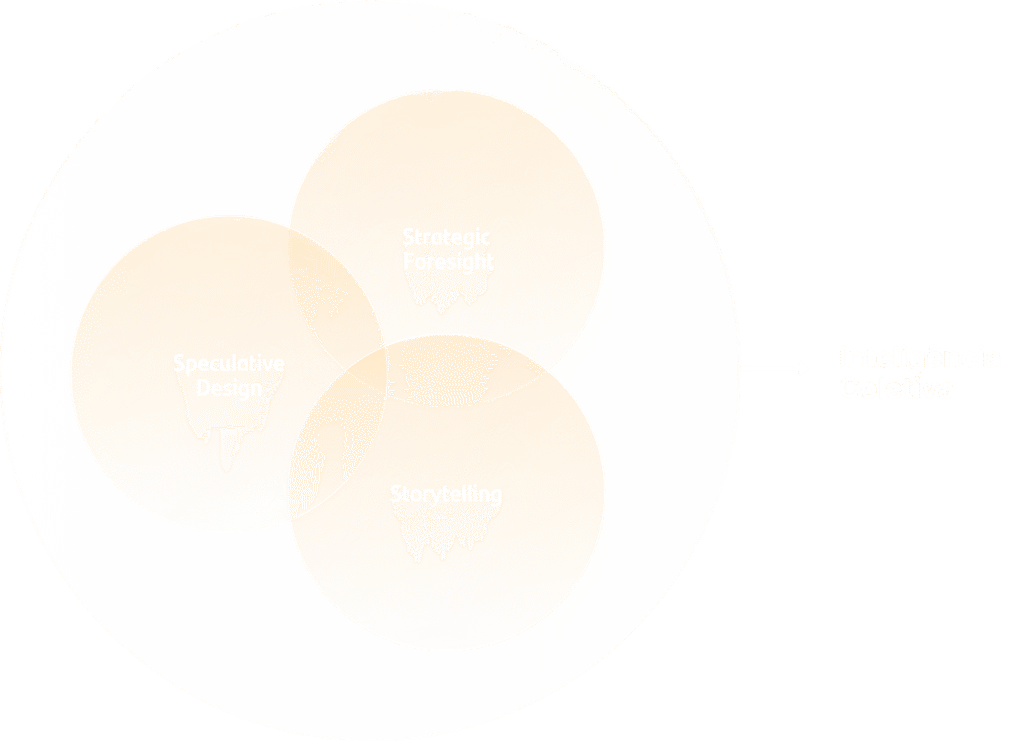
This journey of co-creating futures is not a technical study or an institutional report; it combines tools of strategic foresight, speculative design, storytelling, and collective intelligence, and allows us to build a solid foundation for imagining possible futures and acting on them in the present.
“"What if we had to reinvent education, not for yesterday's world, but for the world that is rapidly approaching?"”
Working lenses
We rely on the best tools available today to To imagine possible futures and mobilize real transformations. in complex systems such as education.
Project Roadmap
July
An invitation to the future
• Launching the project and involving stakeholders in the initial strategic reflection;
• Beginning of the development of the Strategic Radar;
October
Challenges in Education
• Co-construction of the Strategic Radar;
• Identifying influencing forces and critical uncertainties;
• Co-creation of scenarios;
January
Paths of Education
• Presentation of the Scenarios;
• Beginning of the development of the Vision for the Future and Strategic Spaces/Cuts;
April
The Future of Education
• Presentation of the project to Civil Society;
• Immersive experiences;
Methodology
Inspired by approaches of foresight, speculative design, storytelling, and collective intelligence., The methodology operates at the intersection. between critical reflection and creative practice. Their focus is on strategic imagination, that is, the ability to conceive of alternative futures and use them as an instrument for organizational, social, and cultural transformation.

01. Deep Dive
Listening to the present with eyes on the future.
The journey begins with a creative and collaborative immersion into the perceptions, tensions, and aspirations that shape contemporary education. Based on interviews with key stakeholders and participatory sessions, the project constructs a vivid portrait of the present, revealing signs of change and emerging contradictions.

02. Scenarios
Exploring the realm of possibilities
This stage transforms data, signals, and intuitions into alternative futures that challenge common sense. The scenarios do not aim to predict, but to provoke: they broaden the realm of the imaginable, expose strategic tensions, and inspire new ways of thinking about education.

03. Vision for the Future
Sharing what you want to achieve
The Vision for the Future emerges as a symbolic and strategic synthesis of the process; it is a guiding principle that integrates discoveries, values, and collective desires. It is an exercise in convergence between imagination and direction, translating the essence of the educational transformation that the project aims to inspire.

04. Narratives + Experiences
Making the future tangible
At this stage, futures take shape through stories, artifacts, and sensory experiences that allow us to experience what was previously only speculation. Narratives function as bridges between the abstract and the concrete, awakening empathy, reflection, and action.

05. Manifesto
To establish a collective pact.
The lessons and visions built throughout the journey converge into a set of public commitments for the future of education. The manifesto synthesizes the collective energy of the project and formalizes a pact around innovation, equity, and imagination as drivers of educational transformation.

Accelerating the Future
From imagination to action
The final stage translates future-oriented thinking into strategic inspiration for the present. The insights generated throughout the process are organized into action horizons.