Horizons of Education
A Call to the Future

Letter for the Future of Education in Portugal

Shared Vision · Commitments for 2050

Towards a humanistic, inclusive, intelligent, and transformative education — a collective call to build, in Portugal, the educational horizon for the coming decades.

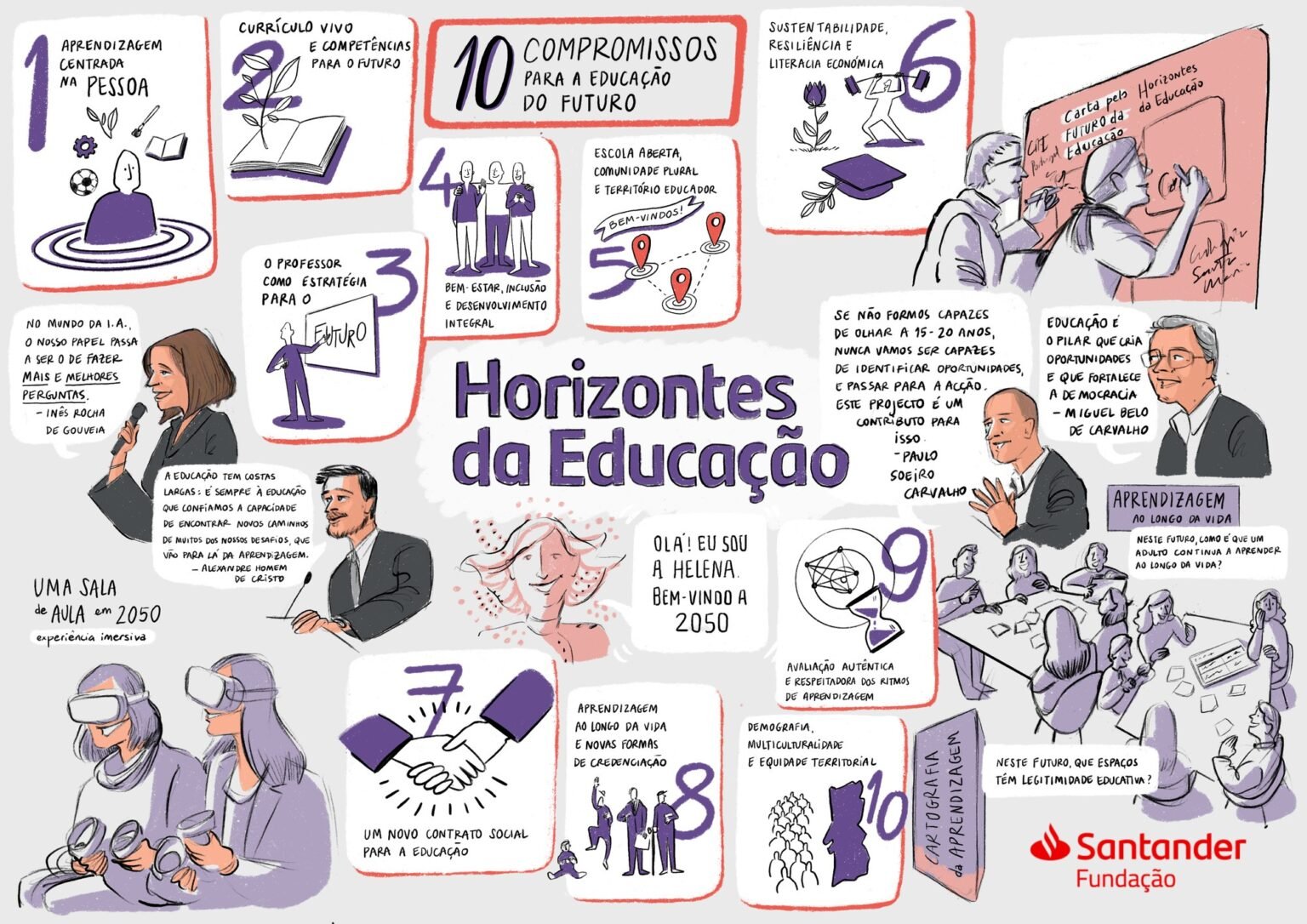
Sintese visual dos 10 Compromissos da Carta pelo Futuro da Educacao
Visual synthesis of the 10 Commitments · Horizons of Education
01Preamble

Education as the infrastructure of the future

Education is one of the most crucial infrastructures for Portugal's future. It encompasses each person's ability to fully develop their potential, ensuring a path from education to employment, the country's democratic vitality, its social cohesion, its capacity for innovation, and its preparedness to respond to profound technological, demographic, economic, environmental, and cultural transformations.

In a time marked by accelerated change, the emergence of artificial intelligence, new pressures on the role of teachers, the need for lifelong learning, demographic aging, mental health concerns, social polarization, climate change, and persistent inequalities, it becomes insufficient to discuss education solely from the perspective of present-day urgencies.

This Charter is an invitation to affirm a common vision for education in Portugal until 2050. It does not intend to replace democratic debate, nor to close off public policy options, nor to prescribe short-term measures. Rather, it seeks to identify a collective long-term direction, sufficiently clear to guide decisions and sufficiently open to accommodate different paths to implementation.

We assume that the future of education cannot be shaped by a single actor, a single generation, or a single institution. It requires collective intelligence, a long-term vision, the courage to imagine, the capacity for commitment, and a shared will to act.

02Vision & Purpose

A common horizon for 2050

The collective direction we advocate for education in Portugal — capable of guiding decisions and embracing multiple paths to implementation.

Vision · 2050

Humanistic, inclusive, intelligent, and transformative education.

By 2050, Portugal will have an education system capable of fully developing each individual, strengthening social cohesion, cultivating democratic citizenship, promoting equity, preparing for a changing world, and expanding the country's collective capacity to create the future.

It will be an education that combines rigor and equity, knowledge and creativity, technology and humanity, belonging and openness to the world — one that values different paths and makes it possible to learn, relearn, and contribute throughout life.

Purpose

To educate people capable of understanding the world and acting.

The purpose of education in Portugal should be to train people capable of understanding the world, acting responsibly, living with others in freedom and respect, creating economic, social, cultural and environmental value, and continuing to learn throughout their lives.

Education should simultaneously serve the integral development of the individual, the strengthening of society, and the country's capacity to respond, intelligently and ethically, to the great challenges of the 21st century.

03The 10 Commitments of the Charter

Ten commitments for the education of the future.

The ten commitments in this Charter correspond to the ten strategic pillars of the Horizons of Education project.

01

Person-Centered Learning

Technology at the service of human learning, not as a replacement for it.
Declaration 01

By 2050, education in Portugal should integrate digital technologies and artificial intelligence in an ethical, critical, and human-oriented way, placing them at the service of learning and not replacing it.

Declaration 02

Learning environments should evolve into smarter ecosystems, capable of supporting diverse learning paths, richer feedback, and better conditions for student monitoring.

Declaration 03

Digital, algorithmic, and ethical literacy should become a central dimension of the education of all citizens, enabling them to understand, use, and critically question the technological systems that shape society.

02

The Teacher as a Strategic Role for the Future

Recognizing the teaching profession as one of the most strategic roles for the future of the country.
Declaration 01

Portugal must, by 2050, establish a new centrality for the teaching profession, ensuring that it embraces the human role of learning and the development of socio-emotional skills.

Declaration 02

The role of teachers should evolve consistently towards more complex functions of mentoring, curation, facilitation, and pedagogical mediation, focusing on the development of skills for the future — critical thinking, creativity, autonomy, collaboration, and human relations.

Declaration 03

Initial training, continuing education, and working conditions should be reconfigured to attract, support, and value the educators of the future.

03

A Living Curriculum and Skills for the Future

An interdisciplinary curriculum, linking solid knowledge with transversal skills relevant to life, citizenship, and work.
Declaration 01

The curriculum should evolve into a living, flexible, and deeply interdisciplinary architecture, capable of integrating different areas of knowledge and articulating solid knowledge with transversal skills relevant to life, citizenship, and work.

Declaration 02

Education should intentionally develop critical thinking, creativity, autonomy, problem-solving skills, emergent literacies, and relational and ethical competencies.

Declaration 03

Learning should become more connected to real-world challenges, concrete contexts, and meaningful interdisciplinary projects, as well as to experiences of creation, experimentation, and collaboration.

04

Well-being, Inclusion and Holistic Development

Well-being, mental health, and inclusion as structural conditions for learning.
Declaration 01

By 2050, the Portuguese education system should consider well-being, mental health, inclusion, and holistic development as structural conditions for learning, not as peripheral dimensions.

Declaration 02

Education should reduce barriers of social, economic, territorial, cultural, functional, and emotional origin, ensuring that more people can learn, progress, and participate in conditions of dignity and belonging.

Declaration 03

Educational institutions should be environments that cultivate trust, relationships, security, a sense of community, and recognition of human diversity.

05

Open School, Plural Community and Educating Territory

Open learning platforms, connected to the territory, the diversity of communities, and the real world.
Declaration 01

Schools and educational institutions, from early childhood to universities, should increasingly assert themselves as open learning platforms, connected to the territory, the community, culture, science, the business sector, and the challenges of the real world, with the autonomy to respond to the needs of their contexts.

Declaration 02

Portugal should promote educational ecosystems in which families, municipalities, cultural and artistic institutions, the economic fabric, associations, and civil society participate in a more structured way in creating learning opportunities, reflecting the country's cultural and demographic diversity.

Declaration 03

Educational spaces and times should become more flexible, collaborative, and connected to the life of communities and different learning contexts, collaborating and contributing to a common national vision.

06

Sustainability, Resilience, and Climate Literacy

Preparing people and institutions for the ecological challenges of the 21st century.
Declaration 01

Education in Portugal should prepare all people to understand, confront, and transform the ecological, climatic, and sustainability challenges that will define the 21st century.

Declaration 02

Sustainability should cease to be a secondary issue and become a cross-cutting dimension of the curriculum, institutional culture, infrastructure, and educational practices.

Declaration 03

The education system should contribute to training individuals capable of promoting resilience, regeneration, and intergenerational responsibility in their lives and organizations.

07

A New Social Contract for Education

Shared responsibility among the State, institutions, professionals, families, and civil society.
Declaration 01

Portugal must build, by 2050, a new social contract for education, based on shared responsibility between the State, institutions, professionals, students, families, businesses, communities and civil society.

Declaration 02

The governance of education should become more participatory, transparent, stable, and guided by long-term commitments, protecting educational transformation from cyclical fluctuations.

Declaration 03

Education should be recognized as a lasting national priority, mobilizing political will, investment, collective intelligence, and agreements for continuity.

08

Lifelong Learning and New Forms of Accreditation

Learning, relearning, and contributing throughout life.
Declaration 01

Education in Portugal should fully embrace lifelong learning as a structuring axis of the education system, and not as a marginal or complementary function.

Declaration 02

The country should evolve towards more flexible, modular, and interoperable models of certification and recognition, valuing formal, non-formal, and experiential learning.

Declaration 03

Educational institutions should broaden their mission, becoming permanent partners of individuals and organizations in lifelong skills development.

09

Authentic Assessment that Respects Learning Pace

From reproduction to understanding, application, creation, and critical thinking.
Declaration 01

Assessment should evolve from models predominantly focused on reproduction, standardization, and short-term memory to more authentic, diverse, and formative approaches.

Declaration 02

The education system should better recognize the diversity of paces, processes, and ways of demonstrating learning, without sacrificing rigor, standards, and quality.

Declaration 03

Assessment and accreditation practices should become more aligned with the challenges of the digital age and artificial intelligence, valuing understanding, application, creation, collaboration, and critical thinking.

10

Demographics, Multiculturalism and Territorial Equity

To respond to aging, cultural diversity, and asymmetries between regions, with equity and a long-term vision.
Declaration 01

Portugal must respond to the aging population and demographic transformation of the coming decades by adjusting its educational offerings to the new age pyramids and lifelong learning needs.

Declaration 02

Education should recognize and value the growing multiculturalism of Portuguese society, integrating the linguistic, cultural, and identity diversity of new audiences as a richness and a pedagogical opportunity.

Declaration 03

Territorial equity should be a guiding principle, ensuring that all people — regardless of age, origin or location — have access to quality, dignified and relevant educational opportunities.

04Final Commitment

A shared horizon.
A collective commitment.

We adopt this Charter as a common horizon for the future of education in Portugal until 2050. We recognize that its realization will require choices, experimentation, investment, continuity, institutional courage, and collective commitment.

We are committed to contributing, from our different roles and responsibilities, to building a more humane, intelligent, just, open, demanding, and future-ready education.

This letter does not end the conversation: it opens a process of co-creation, adherence, and national mobilization around a shared vision for education in Portugal.

We call this new phase the "Future Accelerator".
Horizons of Education · Call for the Future · 2026
Santander Portugal Foundation · Universia · The Long Game

Join the movement. Subscribe and participate in shaping the future of education in Portugal.

Join